
ISO 19650 and the RIBA Plan of Work: how they actually fit together
Towards the end of 2025 I shared a post that sparked a lot of discussion around a question I get asked regularly: Does ISO 19650 replace the RIBA Plan of Work?
The short answer is still no.
ISO 19650 is about how information is managed. The RIBA Plan of Work is about how projects are designed and delivered.
They’re connected, but they’re not the same thing - and treating them as interchangeable is where much of the confusion starts.
This article builds on that earlier post and shares an updated workflow that maps ISO 19650 phases against the RIBA Plan of Work.
One important assumption before anyone dives in
This workflow is based on a traditional form of contract, with one Lead Appointed Party in place for the duration of the project.
That assumption matters.
Most real projects aren’t that tidy:
novation
early contractor involvement
multiple lead roles
hybrid procurement approaches
All of these change when ISO 19650 activities happen and who ends up responsible for them.
This isn’t something to lift and apply without thought. It’s guidance.
RIBA PoW and ISO 19650 Mapping
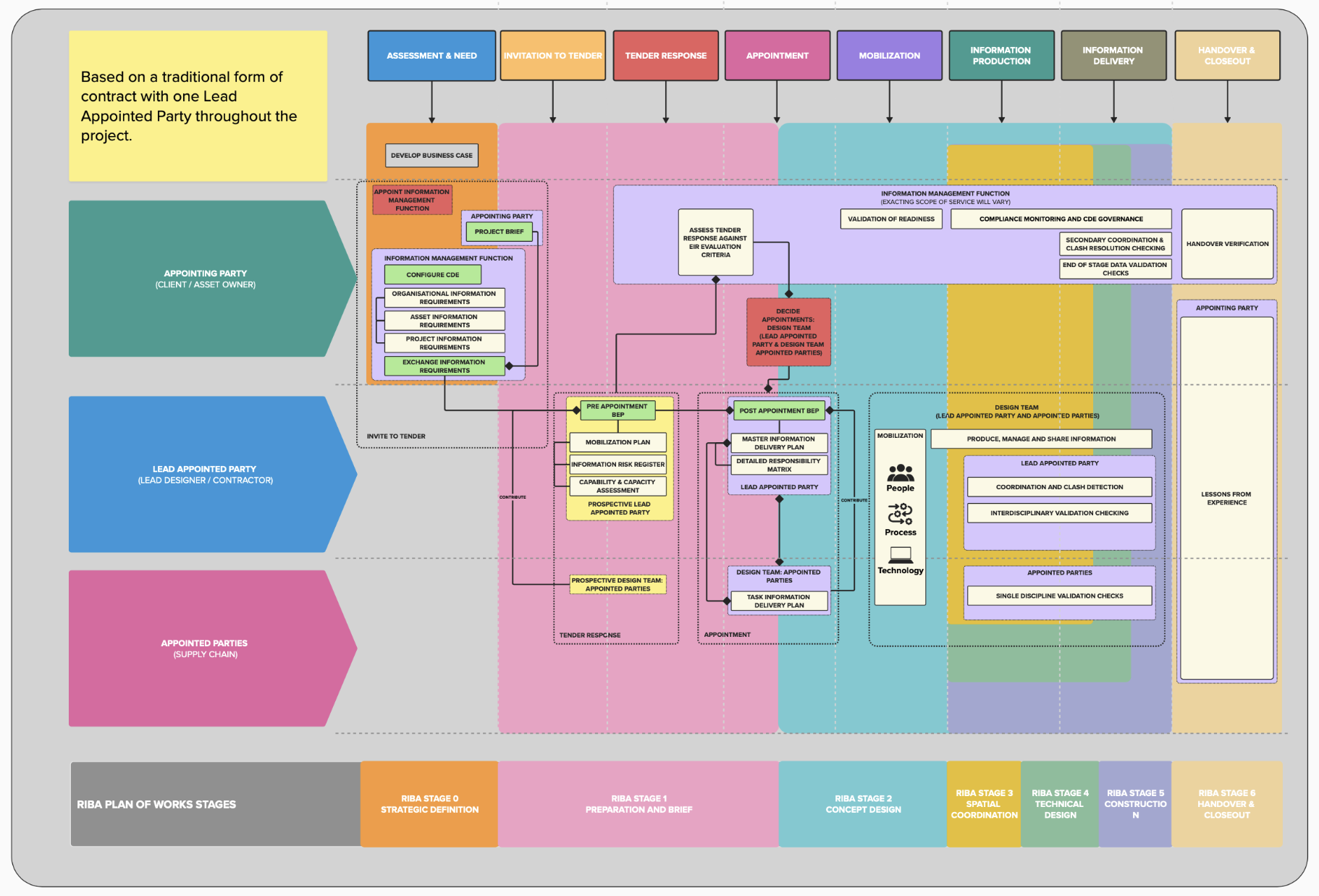
The RIBA Plan of Works - Indicating ISO 19650 activities mapped based on traditional form of contract running from 0 to 6.
What the workflow is actually trying to show
If you were starting a project tomorrow and things lined up reasonably well - a traditional contract, a single Lead Appointed Party, early appointment of the information management role - this is broadly how I would expect a RIBA Plan of Works led project, delivered in line with ISO 19650, to operate.
The mapping is intended to clarify a few key points.
ISO 19650 doesn’t replace RIBA
RIBA sets out the stages of design and delivery. ISO 19650 supports that delivery by setting expectations around information.
Different purposes. Same project.
RIBA stages don’t map neatly to ISO phases
ISO phases covering assessment, tendering, appointment, mobilisation and information delivery do not sit one to one against RIBA stages.
In practice, RIBA stages frequently span multiple ISO phases, particularly around:
briefing
procurement
mobilisation
stage gateways
That overlap is normal - but it’s rarely shown let alone clearly.
The information management role runs all the way through
Information management isn’t something that starts at mobilisation and finishes at handover.
It begins early, evolves as the project progresses and stays relevant through delivery and close-out.
The activities shown in the workflow are examples rather than a checklist, because the real scope will always depend on procurement route and how appointments are set up.
Why this matters
When ISO 19650 is discussed in isolation, it can feel abstract or overcomplicated.
Lined up against something familiar - like the RIBA Plan of Work - it becomes much easier to explain, scope and apply on real projects.
That’s all this mapping is trying to do: make ISO 19650 feel more grounded in how projects are actually delivered.
Where this is heading
This workflow also forms part of a book I’m currently writing - BIM Basics: a no-BS guide to ISO 19650 for clients and designers.
The focus is on explaining information management in plain language, without assuming prior B(IM) or standards knowledge.
Following a suggestion by Steve Sears, I’m also planning to extend this thinking to GRIP / PACE, where I suspect similar questions come up but within a very different delivery context.
Final thought
If this has been useful, I would be interested to hear: whether this kind of mapping reflects how projects actually work in practice and which procurement routes or delivery models would be worth exploring next.